This China train luggage guide explains what foreign visitors should know before taking high-speed trains or other trains in China. Luggage is not only about official limits; it is also about station security, stairs, waiting halls, platforms and transfers after arrival.
For the full transport overview, start with our China transport guide: China transport guide
China train luggage guide: the short answer
Pack lighter than you think if you plan to use high-speed rail.
Prepare for:
- station security screening;
- walking through large stations;
- escalators and stairs;
- storing luggage near your seat or luggage area;
- metro or taxi transfers after arrival;
- keeping valuables with you;
- following current 12306 luggage and restricted-item rules.
12306 luggage limits
12306’s English FAQ lists the maximum free cabin luggage limit for each passenger as:
- 10 kg for children;
- 35 kg for diplomats;
- 20 kg for other passengers.
It also lists maximum dimensions:
- 160 cm total for traditional trains;
- 130 cm total for EMU trains;
- 200 cm for rod-shaped items on traditional trains;
- maximum 20 kg per item.
Check 12306 before publishing or traveling because rules and enforcement details can change.
What is an EMU train?
In practical travel terms, many high-speed trains are EMU trains. For tourists, the important point is that high-speed train luggage size limits may be tighter than traditional train limits.
Station security and restricted items
12306 says all passengers and their belongings are subject to security check when entering the station.
It also lists categories of prohibited or restricted items, including dangerous goods, flammable and explosive items, certain sharp or blunt objects, strong-smelling items and some limited-quantity personal items.
This guide does not reproduce the full legal list. Check 12306 and station rules before traveling with unusual items.
Practical luggage advice
For first-time visitors:
- one medium suitcase is easier than two large bags;
- keep passport and ticket information accessible;
- keep valuables in a small bag;
- avoid packing power banks or electronics deep inside checked-style luggage;
- leave hands free if possible;
- avoid tight metro transfers with heavy luggage;
- use taxi or ride-hailing if luggage is heavy.
Taxi guide: taxi and ride-hailing in China
Where do you put luggage on the train?
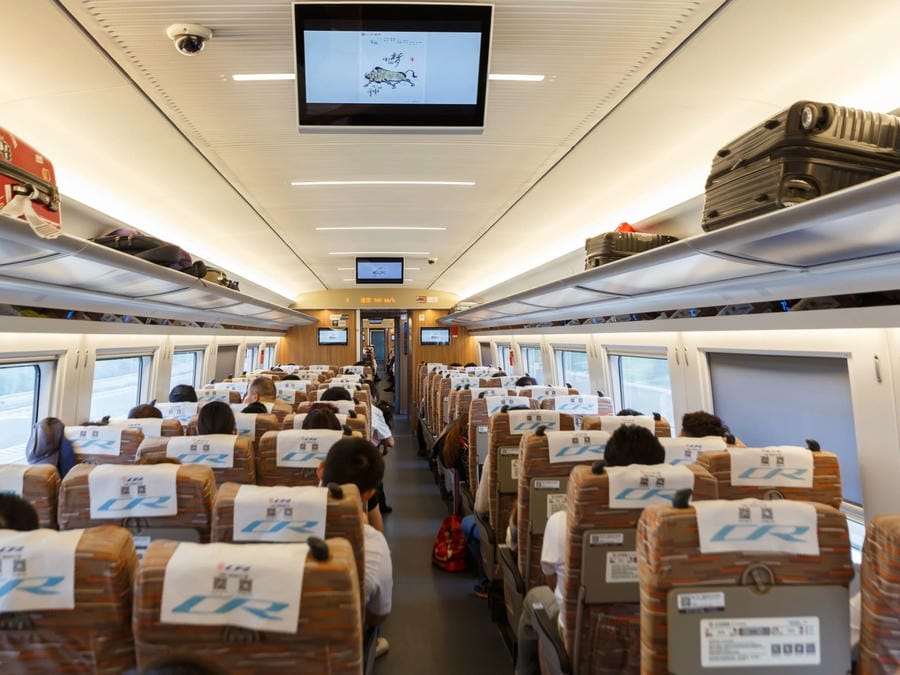
Depending on train type and carriage, luggage may go:
- on overhead racks if small enough;
- in luggage areas near carriage ends;
- near your seat if allowed and not blocking aisles.
Do not block aisles, doors or emergency areas.
Luggage and station transfers
Large stations can involve long walking distances. If you have heavy luggage, allow more time and avoid complicated same-day transfers.
Station flow guide: China train station flow
Arrival-time guide: how early to arrive at Chinese train stations
Luggage and metro after arrival
Metro can be efficient, but heavy luggage makes transfers harder. If your arrival station is far from your hotel or you arrive during rush hour, taxi or ride-hailing may be more practical.
Metro guide: China metro guide
Common mistakes
Do not bring more luggage than you can carry yourself.
Do not ignore EMU size limits.
Do not block aisles with large bags.
Do not pack passport or ticket details in a hard-to-reach place.
Do not bring restricted items without checking current rules.
Do not plan a tight transfer with heavy luggage.
How to use this transport guide on the ground
The practical part of China transport is not only choosing a train, metro or taxi. It is moving through large stations with luggage, using the right document at the gate, and leaving enough time for security checks and platform access. Build a buffer into the plan even when the official timetable looks simple.
For high-speed rail days, keep your passport, booking record and hotel address easy to reach. If you are using a ride-hailing app, copy the Chinese name of the station or hotel before you move. At large stations, follow the train number and departure hall rather than relying only on the English name of the city.
If a transfer looks tight, choose the slower but simpler option. A direct metro line, a later train or a hotel near the station is often better than a route that works only if every app, payment and security step goes perfectly.
Official transport sources to check
For train tickets, station timing and account setup, start with the official 12306 China Railway website and its English FAQ. For city metro, airport and taxi details, check the current airport or city transport page for the specific city you will use.
Chinese rail and metro systems are efficient, but large stations, security checks and peak travel periods can change the real time needed. Use official schedules for tickets and this guide for the traveler workflow around them.
FAQ
How much luggage can I take on China trains?
12306’s English FAQ lists 20 kg free cabin luggage for most passengers, with different limits for children and diplomats.
What is the luggage size limit on China high-speed trains?
12306 lists 130 cm total dimensions for EMU trains and 160 cm total for traditional trains.
Is luggage checked at Chinese train stations?
Yes. 12306 says passengers and belongings are subject to security check when entering stations.
Can I take a large suitcase on a China high-speed train?
Often yes if it fits rules and storage, but very large luggage can be inconvenient in stations, aisles and metro transfers.
Last reviewed
Last reviewed: 2026-07-14
Sources checked: 12306 English FAQ luggage and security sections.