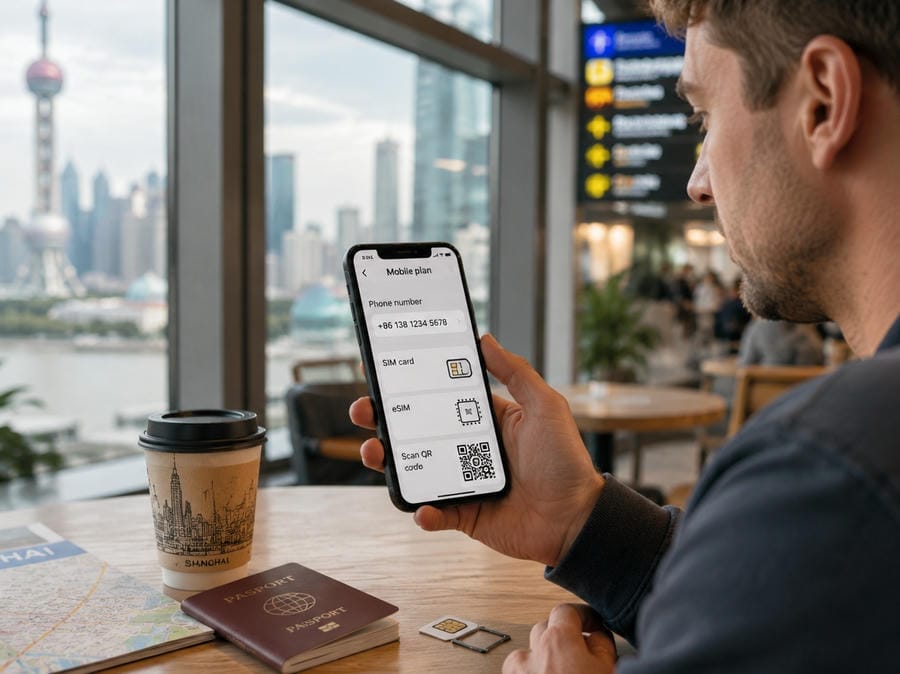
Comparing China SIM card vs eSIM vs roaming is one of the first internet decisions foreign visitors should make before departure. For most short-term travelers, a China eSIM is the easiest option; for longer stays, a local SIM card may be better; for business travelers, roaming can be convenient if the cost is acceptable.
For the full overview, start with our China eSIM and internet guide: China eSIM and internet guide
China SIM card vs eSIM vs roaming: quick comparison
| Option | Best for | Main advantage | Main limitation |
|---|---|---|---|
| China eSIM | Short trips, first-time visitors | Setup before departure | Usually data-only |
| Local China SIM card | Longer stays, local number needs | Chinese number, local calls/SMS | Store visit and ID check |
| International roaming | Business travelers, simple setup | Keeps home number active | Can be expensive |
| Wi-Fi only | Backup use | Cheap or free | Not enough for daily travel |
Option 1: China eSIM
A China eSIM is usually the best first option for short-term visitors.
Choose eSIM if you want:
- fast setup before travel;
- no store visit after arrival;
- mobile data for maps and payments;
- simple airport-to-hotel connectivity;
- a plan that can be bought online.
Limitations:
- many plans are data-only;
- no Chinese phone number in many cases;
- app access differs by provider and routing;
- hotspot may not be included;
- your phone must support eSIM;
- your phone must be unlocked.
China eSIM guide: China eSIM guide
Option 2: Local China SIM card
A local China SIM card can be a better option if you need a Chinese phone number or are staying longer.
Choose local SIM if you need:
- local calls;
- local SMS;
- restaurant or delivery verification;
- repeated business coordination;
- supplier calls;
- longer-stay data packages;
- a domestic number for local services.
Limitations:
- passport or ID check may be required;
- store visit can take time;
- English support varies;
- your phone must be unlocked;
- network band compatibility matters;
- app access follows mainland China network conditions.
Chinese phone number guide: Chinese phone number for travel
Option 3: International roaming
International roaming is the simplest option if your carrier plan is good.
Choose roaming if:
- your employer pays;
- your plan includes China data;
- you need your home number active;
- you want minimal setup;
- you need bank SMS and two-factor authentication.
Limitations:
- roaming can be expensive;
- data caps may be low;
- speeds may be reduced;
- hotspot rules vary;
- app access depends on carrier routing;
- customer support can be harder overseas.
Option 4: Wi-Fi only
Wi-Fi should be a backup, not a main plan.
Wi-Fi can help at:
- hotels;
- airports;
- railway stations;
- cafes;
- malls;
- exhibition venues.
But Wi-Fi is weak for:
- maps outside;
- mobile payments;
- taxis and ride-hailing;
- translation in real time;
- emergency contact;
- restaurant QR menus;
- moving around a new city.
Free Wi-Fi guide: free Wi-Fi in China
Best option by trip type
Short tourist trip
Best: China eSIM.
Backup: home SIM for SMS and hotel Wi-Fi.
24-hour or 240-hour transit
Best: China eSIM or roaming.
Avoid: local SIM setup unless you have a long stay.
Business trip
Best: company roaming plus China eSIM backup, or reliable eSIM plus home SIM for SMS.
Add: company-approved app-access plan.
Canton Fair trip
Best: China eSIM before arrival, backup roaming, WeChat ready, power bank.
Consider: local number if supplier calls and logistics are important.
Longer stay
Best: local China SIM card, with eSIM or roaming for arrival backup.
Cost comparison logic
Do not compare only headline prices.
Compare:
- total data included;
- validity period;
- overage charges;
- speed throttling;
- hotspot rules;
- refund policy;
- support availability;
- whether phone number is included;
- whether app access meets your needs;
- whether your trip includes multiple destinations.
The cheapest plan can become expensive if it fails on arrival.
App access comparison
Different options may affect app access differently.
- Local SIM: strong local network, but overseas apps may not work normally.
- Travel eSIM: may route data differently depending on provider.
- Roaming: may follow your home carrier’s roaming setup.
- Wi-Fi: depends on the network you join.
Do not assume any option guarantees access to all overseas apps.
VPN/app access guide: VPN and app access in China
Setup time comparison
eSIM
Best setup time: before departure.
Risk: device compatibility or activation mistake.
Local SIM
Best setup time: after arrival at store or counter.
Risk: queue, language, ID check, phone compatibility.
Roaming
Best setup time: before departure through home carrier.
Risk: high charges or unexpected plan limits.
Wi-Fi
Best setup time: when available.
Risk: no coverage when moving.
Recommended setup for most visitors
For most short-term travelers:
- China eSIM as main data.
- Home SIM active for SMS.
- Roaming as emergency backup if affordable.
- Hotel Wi-Fi as secondary backup.
- Offline hotel address and translation.
- Power bank.
Internet backup plan: China internet backup plan
Common mistakes
Do not compare only price.
Do not assume data-only eSIM includes a phone number.
Do not buy a local SIM for a short layover.
Do not rely only on Wi-Fi.
Do not forget your phone must be unlocked.
Do not assume roaming is cheap.
Do not ignore app access and two-factor authentication.
Internet source note
Internet access advice depends on your device, roaming plan, app needs and carrier restrictions. Treat this guide as a preparation checklist, then confirm the current details with your mobile carrier, eSIM provider, VPN provider and the official app support pages before you leave.
The practical rule is to set up access before arrival, keep a backup connection option, and avoid waiting until you are in China to discover that an app, verification code or payment flow needs a connection you do not yet have.
External checks before you travel
For internet setup, compare this guide with your own carrier’s roaming page and provider support before departure. Useful starting points include China Mobile International for roaming/network context and China Unicom CUniq for travel SIM/eSIM-style products. Provider terms change, so use those pages to verify coverage, device compatibility and support before purchase.
FAQ
Is eSIM better than a SIM card in China?
For short trips, eSIM is usually easier. For longer stays or travelers needing a Chinese number, a local SIM card may be better.
Is roaming better than eSIM in China?
Roaming is simpler if your plan is affordable and reliable. eSIM is often cheaper and easier to control for tourists.
Do I need a local SIM card in China?
Not for most short tourist trips. You may need one if you want a Chinese phone number or local calls and SMS.
Can I rely only on Wi-Fi in China?
Not recommended. You need mobile data for payments, maps, taxis, translation and emergencies.
What is the best internet option for Canton Fair visitors?
A China eSIM before arrival plus backup roaming is usually practical. Consider a local number if local calls and business coordination matter.
Last reviewed
Last reviewed: 2026-07-05
Sources checked: Apple eSIM setup support; Apple Asia-Pacific carrier support page; Reuters China eSIM trial approval reports; source-library SIM and Wi-Fi competitor pages. Recheck provider and carrier details before publishing.