China visa-free transit can be useful if you are flying through mainland China on the way to another country or region. But it is also one of the easiest China entry rules to misunderstand.
Visa-free transit is not the same as normal visa-free tourism. It usually depends on your nationality, route, port of entry, onward ticket, stay time, and whether you leave the airport or stay airside.
For the full entry decision flow, start with our China entry and visa guide: China entry and visa guide
The short answer
China has two important transit situations foreign travelers often ask about:
- 24-hour direct transit: for eligible passengers transiting through China to a third country or region within 24 hours. If you do not leave the restricted area of the port at certain airports, you may not need to go through immigration inspection procedures.
- 240-hour visa-free transit: for eligible nationals transiting through China to a third country or region through designated ports and allowed stay areas. This can allow temporary entry for up to 240 hours, subject to immigration inspection and approval.
The details matter. A long layover alone does not automatically mean you can enter China.
Visa-free transit is not normal visa-free entry
Normal visa-free entry is based mainly on your passport country, passport type, travel purpose, and allowed stay period.
Visa-free transit is based on a transit route. You must usually be traveling from one country or region, through mainland China, onward to a third country or region.
Example that may qualify in principle:
- Singapore → Shanghai → Japan
- United States → Beijing → Hong Kong
- France → Guangzhou → Thailand
Example that usually does not qualify as transit:
- Singapore → Shanghai → Singapore
- Japan → Beijing → Japan
- United States → Guangzhou → United States
Always check the exact rule, ticketing and port requirements before relying on any example.
What counts as a third country or region?
For China transit rules, Hong Kong, Macao and Taiwan are often treated as separate regions for route purposes. That means a route such as Country A → Mainland China → Hong Kong may be treated differently from Country A → Mainland China → Country A.
Still, do not rely on this alone. Your route, ticket, port, nationality and final destination documents must all work together.
24-hour direct transit
The 24-hour direct transit policy is for passengers who transit through China to a third country or region within 24 hours.
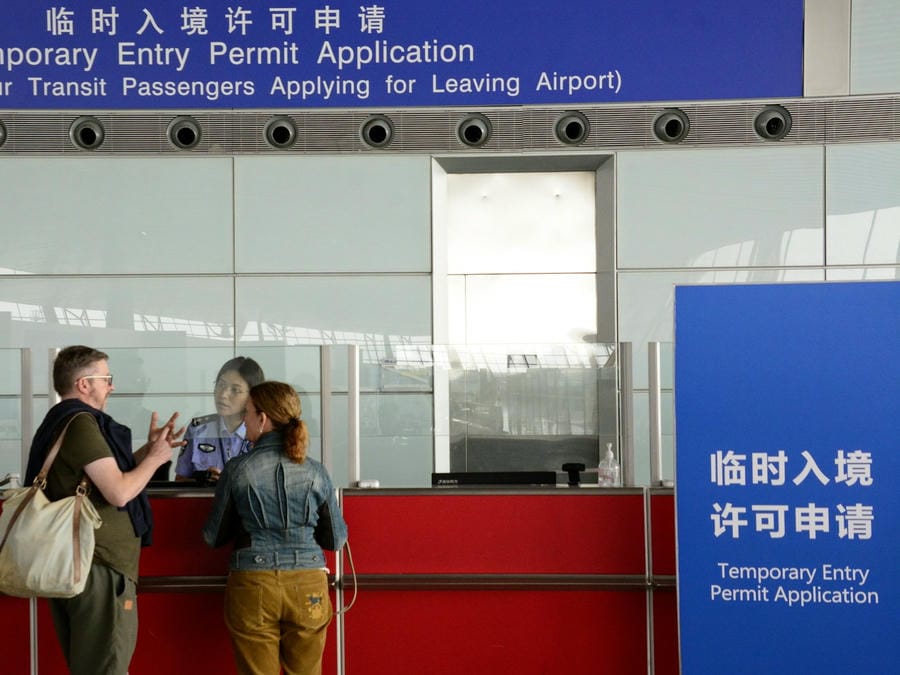
NIA’s older English interpretation says foreigners holding an interline ticket of an international aircraft, ship or train transiting through China to a third country or region within 24 hours may be exempted from visa application if they do not leave the port. If they intend to leave the port, they should apply for a temporary entry permit at the entry-exit frontier inspection station.
NIA’s November 2025 announcement also expanded the scope of certain airports where eligible 24-hour direct transit passengers may be exempted from immigration inspection procedures if they do not leave the airport restricted area.
Practical meaning:
- If you stay airside and your bags are checked through, the process may be simpler.
- If you want to leave the airport, you need immigration permission.
- A 24-hour layover does not guarantee permission to enter the city.
240-hour visa-free transit
The 240-hour policy is broader than a simple airside connection. It can allow eligible travelers to enter China temporarily and stay within permitted areas for up to 240 hours.
At the last source check for this draft, NIA said the policy applies to citizens of 55 eligible countries, through 65 ports in 24 provinces, autonomous regions and municipalities.
To apply, you generally need:
- nationality from an eligible country;
- a valid international travel document;
- passport validity of at least 3 months according to NIA’s listed conditions;
- proof that you meet entry requirements for the third country or region;
- an interline ticket or proof of onward travel to a third country or region within 240 hours;
- completion of the Arrival Card for Temporary Entry Foreigners;
- cooperation with immigration inspection.
Full guide: 240-hour visa-free transit in China
Can you leave the airport?
Only if you are allowed to enter temporarily.
If you are using 24-hour direct transit and remain inside the restricted airport area, you may not need to complete normal immigration entry procedures. If you want to leave the airport, you need to apply for temporary entry.
If you are using 240-hour visa-free transit, you must pass immigration inspection and stay within the allowed area.
Detailed layover guide: leaving the airport during a China layover
Documents to prepare
Prepare:
- passport;
- onward ticket to a third country or region;
- visa or entry proof for that destination if required;
- hotel booking or stay address if entering China;
- arrival card information;
- travel itinerary;
- proof of funds or business visit details if relevant;
- airline booking references;
- phone with working data.
Immigration preparation guide: what to prepare before China immigration
Common mistakes
Do not confuse 240-hour transit with 30-day visa-free entry.
Do not book a round trip and assume it qualifies as transit.
Do not assume every airport participates in every transit policy.
Do not assume a separate-ticket itinerary will be treated the same as a through ticket.
Do not assume you can leave the airport just because your layover is long.
Do not rely on outdated 72-hour or 144-hour guides without checking the current 240-hour rules.
Practical decision flow
Ask these questions:
- Is my nationality eligible?
- Am I traveling to a third country or region?
- Is my onward ticket confirmed and within the time limit?
- Is my entry port included?
- Is my planned stay area allowed?
- Do I need to leave the airport?
- Can I prove entry eligibility for the onward destination?
- Will the airline board me with this itinerary?
If any answer is unclear, check official sources before booking.
Official policy sources to check
China entry and transit rules can change by nationality, port, routing and date. Before relying on this guide, check the National Immigration Administration update on the 240-hour visa-free transit policy, the NIA visa-free transit policy explainer, and the relevant Chinese embassy or visa center page for your country.
Use this article as a planning framework, then verify your passport validity, onward ticket, eligible route and permitted stay area against the official source before you book a non-refundable itinerary.
FAQ
Is China visa-free transit the same as visa-free entry?
No. Visa-free transit depends on a transit route through China to a third country or region. Visa-free entry depends more on nationality, passport type, travel purpose and stay length.
Can I use China visa-free transit for a round trip?
Usually no. A route like Country A → China → Country A is generally not a transit to a third country or region.
Can I leave the airport during 24-hour transit?
Only if you apply for and receive temporary entry permission from the border inspection authority.
Does Hong Kong count as a third region?
Hong Kong is often treated as a separate region for route purposes, but you should verify your exact itinerary with official sources and your airline.
Should I ask my airline before flying?
Yes. Airlines may check whether your documents and route support boarding.
Last reviewed
Last reviewed: 2026-07-03