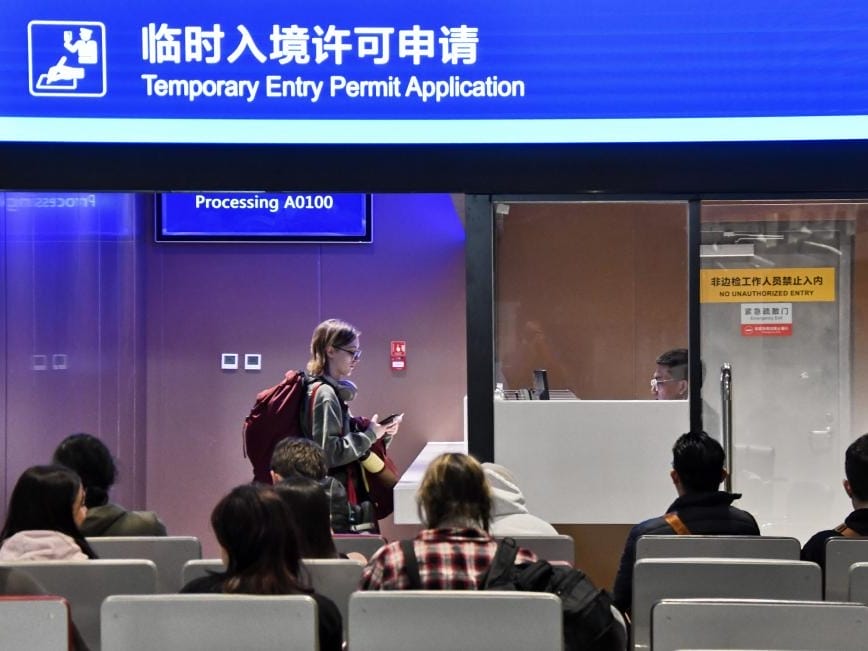
China’s 240-hour visa-free transit policy can let eligible travelers enter mainland China temporarily while traveling onward to a third country or region.
It is useful for travelers who want to visit a city during a longer stopover or build China into a multi-country itinerary. But it is not a general replacement for a visa, and it is not the same as 30-day visa-free entry.
For the full entry decision flow, start with our China entry and visa guide: China entry and visa guide
The short answer
You may be able to use the 240-hour visa-free transit policy if:
- your nationality is on the eligible-country list;
- your passport or travel document is valid enough;
- you are traveling through China to a third country or region;
- you have confirmed onward travel within 240 hours;
- you enter through an eligible port;
- you stay within the permitted area;
- you complete the required arrival card or temporary entry information;
- the immigration authority approves temporary entry.
Do not book based only on nationality. Route, port and stay area matter just as much.
What changed
China previously had 72-hour and 144-hour transit-without-visa arrangements in many travel discussions. The current practical focus is the expanded 240-hour policy.
At the last source check for this draft, NIA’s November 3, 2025 announcement stated that the 240-hour policy applies to citizens of 55 eligible countries through 65 ports in 24 provinces, autonomous regions and municipalities. It also added five Guangdong ports, increasing the number of applicable ports from 60 to 65.
Older 72-hour and 144-hour articles may be outdated or incomplete. Always check the current NIA page before relying on a route.
Who may qualify
According to NIA’s listed conditions, the applicant must be a citizen of one of 55 eligible countries.
NIA’s November 2025 appendix grouped these as:
- Europe: 40 countries;
- Americas: 6 countries;
- Oceania: 2 countries;
- Asia: 7 countries.
Passport and travel document requirements
NIA’s listed conditions state that the applicant must hold a valid international travel document with at least 3 months of validity and meet the requirements for entering the third country or region.
Practical checklist:
- passport valid for at least 3 months under the NIA condition;
- enough blank pages if relevant;
- no document damage;
- proof you can enter the onward country or region;
- matching name across tickets and passport.
Some airlines or destinations may require longer passport validity than China’s transit condition. Check all parts of the itinerary.
Route rule: you need a third country or region
The route must be a real transit route.
Examples that may work in principle:
- United States → Shanghai → Japan
- Singapore → Guangzhou → Hong Kong
- United Kingdom → Beijing → South Korea
- Australia → Chengdu → Thailand
Examples that usually do not work:
- United States → Shanghai → United States
- Singapore → Guangzhou → Singapore
- Japan → Beijing → Japan
Hong Kong, Macao and Taiwan may be treated as separate regions for route purposes, but the exact itinerary still matters.
Ticket requirement
NIA’s conditions refer to interline tickets to a third country or region with confirmed arrangements and departure dates within 240 hours, or other proof documents.
Practical meaning:
- have confirmed onward travel;
- keep booking references accessible;
- make the route easy to understand;
- avoid unclear separate-ticket plans if you cannot explain them;
- carry destination-country visa or entry proof if needed.
If an airline cannot confirm that you are eligible, boarding can become a problem before you even reach China.
Time calculation
NIA states that the visa-free stay period is calculated from 0:00 on the day following the day of entry.
This means the time calculation is not simply “240 hours from landing” in the everyday sense. For publishing, use NIA’s wording and avoid over-simplifying the calculation.
Practical advice:
- build buffer time into your plan;
- do not schedule departure at the last possible minute;
- consider flight delays, airport transfer and immigration processing;
- keep proof of onward travel clear.
Ports and allowed stay areas
The 240-hour policy applies only through designated ports and permitted stay areas.
NIA’s November 2025 announcement lists 65 ports across 24 provinces, autonomous regions and municipalities. These include major airports in Beijing, Shanghai, Guangzhou, Shenzhen, Chengdu, Xi’an and other cities, plus selected land, sea and rail ports.
Do not assume every airport, train station or ferry terminal qualifies. Do not assume you can travel anywhere in China after entering. Stay within the allowed area for your port and policy.
What can you do during the stay?
NIA’s announcement says eligible travelers may engage in tourism, business, visiting, family visits and other activities during their stay. It also says activities such as work, study and news reporting that require prior approval should be carried out with the necessary visas in advance.
For a travel website, explain this carefully: short business visits may be possible under the policy, but working in China is not the same as attending meetings.
Arrival card and temporary entry
NIA’s conditions say travelers should fill in the Arrival Card for Temporary Entry Foreigners and cooperate with inspection by immigration authorities.
Related guide: China arrival card and immigration process
Prepare:
- passport;
- onward ticket;
- hotel or stay address;
- arrival card information;
- destination-country entry proof if needed;
- itinerary inside the permitted area.
Common mistakes
Do not assume nationality alone is enough.
Do not book a round trip and call it transit.
Do not enter through a non-eligible port.
Do not travel outside the permitted stay area.
Do not overstay the allowed time.
Do not use this route for work, study or news reporting if a visa is required.
Do not rely on outdated 144-hour articles.
Practical examples
Possible route example
Paris → Shanghai → Tokyo
This may be a valid transit pattern if the traveler is from an eligible country, has proper documents, enters through an eligible port, stays within the permitted area, and departs within the allowed time.
Problem route example
Paris → Shanghai → Paris
This is a round trip, not a third-country transit pattern.
Region route example
London → Guangzhou → Hong Kong
This may be treated as a third-region transit pattern, but the traveler still needs to meet nationality, document, port, onward ticket and stay-area requirements.
Before you book
Check:
- Your nationality.
- Passport validity.
- Route pattern.
- Entry port.
- Exit route and timing.
- Allowed stay area.
- Hotel address.
- Arrival card requirements.
- Airline boarding requirements.
- Destination-country entry rules.
Official policy sources to check
China entry and transit rules can change by nationality, port, routing and date. Before relying on this guide, check the National Immigration Administration update on the 240-hour visa-free transit policy, the NIA visa-free transit policy explainer, and the relevant Chinese embassy or visa center page for your country.
Use this article as a planning framework, then verify your passport validity, onward ticket, eligible route and permitted stay area against the official source before you book a non-refundable itinerary.
Related planning guides
For the next planning step, compare this guide with China visa-free transit, leaving the airport during a China layover and what to prepare before China immigration.
FAQ
Is the 240-hour policy a visa?
No. It is a visa-free transit policy for eligible travelers who meet the conditions.
Can I enter China for 10 days under this policy?
Possibly, if you meet all 240-hour transit requirements. Do not treat it as normal 10-day tourism entry.
Can I travel to another Chinese province during 240-hour transit?
Only if the permitted stay area for your entry route allows it. Check the NIA port and stay-area list.
Can I work during 240-hour transit?
No, not if the activity requires prior approval or a work visa. NIA specifically distinguishes tourism/business/visiting activities from work, study and news reporting that require visas.
Does my onward flight need to be on the same ticket?
NIA refers to interline tickets or proof documents with confirmed arrangements. Because airline boarding practice can vary, keep your itinerary clear and confirm with your airline.
Last reviewed
Last reviewed: 2026-07-03