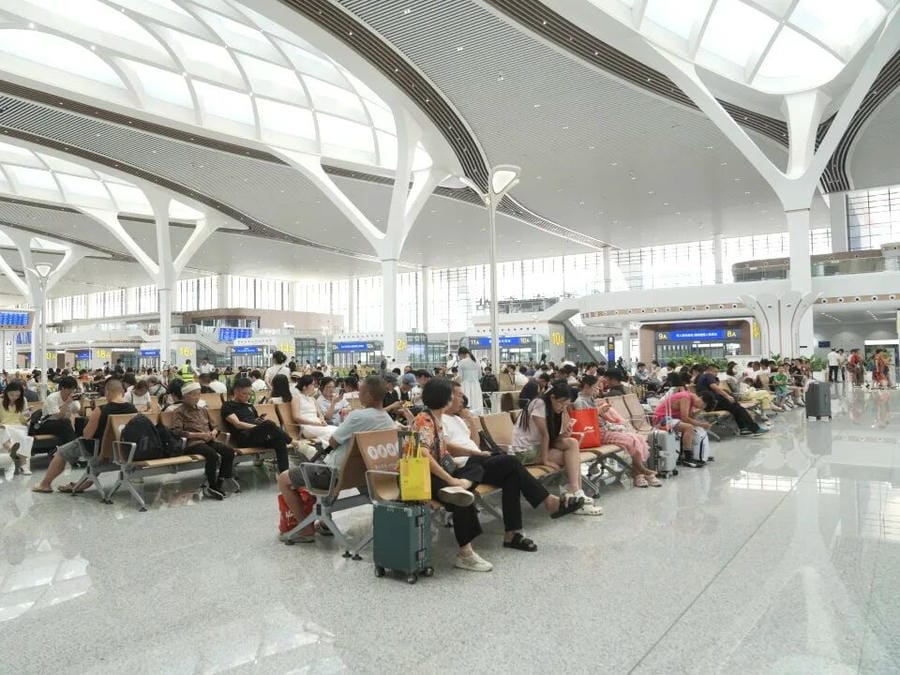
Understanding the China train station flow helps foreign visitors avoid confusion at large high-speed rail stations. Many stations work more like airports than small railway stops, with security screening, ticket and identity checks, large waiting halls and timed boarding gates.
For the full transport overview, start with our China transport guide: China transport guide
China train station flow: the short answer
A typical trip works like this:
- Arrive at the correct station.
- Enter the station building.
- Pass security screening.
- Complete ticket and passport/ID verification.
- Find your waiting hall or gate area.
- Watch the display for train number and boarding gate.
- Queue when boarding opens.
- Pass the boarding gate.
- Go to the platform.
- Find carriage and seat.
- Keep passport accessible.
- Exit the arrival station.
Step 1: Arrive at the correct station
Many Chinese cities have multiple railway stations. Check the exact station name before leaving your hotel.
Examples of station-name risk:
- main station vs south station;
- west station vs east station;
- airport station vs city station;
- high-speed rail station far from city center.
Map guide: China map apps for tourists
Step 2: Security screening
12306’s English FAQ says all passengers and their belongings are subject to security check when entering the station. Passengers should place baggage and belongings in the dangerous goods inspection machine and pass through the security gate.
Practical advice:
- keep passport and ticket information accessible;
- remove bags for screening quickly;
- avoid carrying restricted items;
- allow time for queues.
Step 3: Ticket and passport/ID check
12306 explains that passengers should keep e-ticket information and the valid ID document used to purchase the ticket, and show that document to check in and out of the station and board the train.
For most foreign visitors, this means the passport used to buy the ticket.
12306 guide: 12306 guide for foreign travelers
Step 4: Waiting hall and display screens
After entering, find your waiting hall or gate. Watch display boards for:
- train number;
- departure time;
- destination;
- gate number;
- boarding status;
- platform changes;
- announcements.
Do not rely only on memory. Train numbers matter.
Step 5: Boarding gate
Boarding usually opens before departure and closes before the train leaves. Follow station displays and staff instructions.
For first-time visitors, stand near the gate once boarding time approaches.
Arrival-time guide: how early to arrive at Chinese train stations
Step 6: Platform, carriage and seat
After passing the gate, follow signs to the platform. Find your carriage number first, then seat number.
High-speed train platforms can be long. Do not wait at the wrong end of the platform if your carriage is far away.
Step 7: Arrival and exit
At the arrival station, follow exit signs. You may need the same ID document or ticket information for exit checks depending on station flow.
Plan the next step before arrival:
- metro;
- taxi;
- ride-hailing;
- hotel pickup;
- walking route;
- transfer to another train.
Common mistakes
Do not go to the wrong station.
Do not pack your passport deep inside your luggage.
Do not ignore security queues.
Do not wait far from the gate.
Do not confuse train number with destination name only.
Do not underestimate platform walking distance.
How to use this transport guide on the ground
The practical part of China transport is not only choosing a train, metro or taxi. It is moving through large stations with luggage, using the right document at the gate, and leaving enough time for security checks and platform access. Build a buffer into the plan even when the official timetable looks simple.
For high-speed rail days, keep your passport, booking record and hotel address easy to reach. If you are using a ride-hailing app, copy the Chinese name of the station or hotel before you move. At large stations, follow the train number and departure hall rather than relying only on the English name of the city.
If a transfer looks tight, choose the slower but simpler option. A direct metro line, a later train or a hotel near the station is often better than a route that works only if every app, payment and security step goes perfectly.
Official transport sources to check
For train tickets, station timing and account setup, start with the official 12306 China Railway website and its English FAQ. For city metro, airport and taxi details, check the current airport or city transport page for the specific city you will use.
Chinese rail and metro systems are efficient, but large stations, security checks and peak travel periods can change the real time needed. Use official schedules for tickets and this guide for the traveler workflow around them.
FAQ
What is the China train station flow for foreigners?
Arrive at the correct station, pass security, complete ticket and passport/ID checks, wait for boarding, pass the gate, find the platform, carriage and seat, then exit at the destination.
Do Chinese train stations have security checks?
Yes. 12306 says all passengers and belongings are subject to security check when entering the station.
Do I need my passport at the train station?
Yes. Carry the passport used for ticket purchase because station and boarding checks may use that document.
Are Chinese train stations large?
Many high-speed rail stations are large and can involve long walks, queues and multiple levels. Arrive early.
Last reviewed
Last reviewed: 2026-07-15
Sources checked: 12306 English FAQ; Transport Pillar.